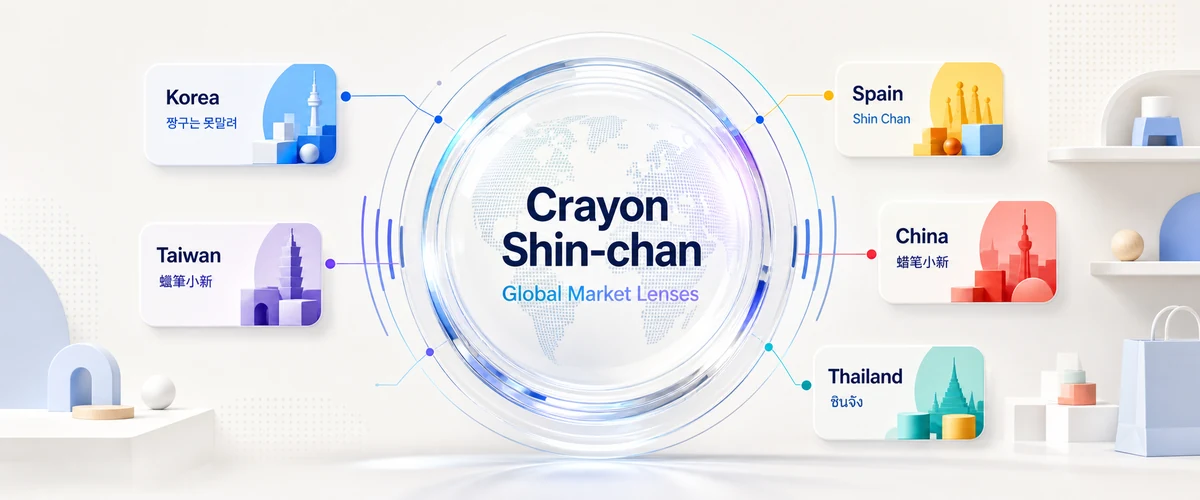
Crayon Shin-chan is often described as a global anime and character franchise, but that phrase can hide the most interesting part of the story: the IP does not travel through one universal popularity formula. In Korea, it is supported by survey-backed recognition and character-goods compatibility. In Taiwan, it benefits from family-anime familiarity and licensed merchandise visibility. In Spain, it has unusual licensing continuity and adult nostalgia. In Mainland China, the clearest public signals are collectible-toy and licensing-market visibility. In Thailand, the strongest safe evidence is brand-campaign, retail, and licensed product visibility rather than a national ranking claim.
This article treats Crayon Shin-chan as a case study in IP adaptability. It looks at how local names, distribution history, retail channels, and public demand signals help the same character franchise fit different market contexts.
IP Ranking measures public demand signals, not official audience totals, distribution tallies, financial value, or licensing income. For current anime ranking context, see Anime Popularity Ranking and Top Anime Franchises. For methodology and data limitations, see Methodology, Open Data, and IP Ranking data sources.
Local Names and Market Lenses
| Market | Local / common title | Market lens for this article |
|---|---|---|
| Korea | 짱구는 못말려 | Survey-backed animation and character recognition, plus ongoing broadcast visibility. |
| Mainland China | 蜡笔小新 | Licensed collectible/toy activity, retail visibility, and IP-rights context. |
| Taiwan | 蠟筆小新 | Long-running family-anime familiarity and authorized merchandise visibility. |
| Thailand | ชินจัง | Brand-campaign, retail, and licensing visibility, with popularity claims treated cautiously. |
| Spain / Catalonia | Shin chan / Shin-chan | Formal licensing and distribution continuity, nostalgia, and Spanish-language fan-community signals. |
Korea: Why 짱구는 못말려 Still Has Durable Recognition
Korea is the market where this analysis can make the strongest recognition claim, because the evidence is not only anecdotal. KOCCA / MCST animation preference research identifies Crayon Shin-chan among selected non-theatrical animation titles, and Korean character preference research also includes the IP among character choices. That does not prove a single national rank, but it does support a safer claim: 짱구는 못말려 remains a recognized animation and character IP in Korea.
The Korean case is also useful because it shows how Shin-chan works beyond viewing alone. The character design, catchphrases, family setting, and everyday comedy translate into character-goods compatibility. A title can maintain recognition because people remember the show, but also because the character remains easy to place on goods, retail displays, collaborations, and nostalgic media surfaces.
Ongoing broadcaster visibility reinforces that pattern. Tooniverse maintains a Korean program page for Shin-chan Season 24, which supports the idea that the franchise still has formal media presence. The safe wording is not that Shin-chan dominates Korean television. The safer claim is that Korea provides survey-backed recognition plus continued broadcast and character-commerce fit.
Taiwan: 蠟筆小新 and Long-Running Family-Anime Familiarity
Taiwan is best understood through family-anime familiarity and licensed merchandise visibility. The local title 蠟筆小新 is widely recognizable, and Taiwan has authorized merchandise channels that show the character's ongoing retail presence. This makes Taiwan different from markets where the evidence is mostly social or anecdotal.
MUSE-related Taiwan-market context also points to Crayon Shin-chan as a long-running family-oriented title. That matters because Shin-chan's international adaptability is not only about jokes. In many markets, the franchise functions as a familiar household animation brand: mischievous enough to feel distinctive, but stable enough to support family viewing, character goods, and retail promotions.
For article framing, Taiwan should not be presented as proof of a precise audience size. The better claim is that 蠟筆小新 has durable local familiarity and authorized merchandise visibility, which together make Taiwan an important example of Shin-chan's family-anime and character-commerce layer.
Spain and Catalonia: Shin chan, Nostalgia, and Licensing Continuity
Spain is one of the strongest markets for a licensing-and-distribution argument. LUK Internacional presents Shin chan as a managed licensing property for Spain and Portugal, and its materials point to formal brand activity, promotional use, and a sizable Spanish-language fan community. That gives the Spain section a firmer base than social-media chatter alone.
The Spain case also has a different emotional center from Korea or Taiwan. Shin chan in Spain is not only a children's animation memory; it also carries adult nostalgia. Viewers who encountered the show earlier now form part of the audience for clips, merchandise, and brand references. That does not mean every Spanish viewer experiences Shin chan the same way, and this article should avoid unsupported claims about uncensored appeal. The safer point is that Spain shows how a localized comedy brand can become a nostalgia asset while remaining usable in current licensing and distribution.
Spain should also not be described as the franchise's largest international market unless a primary licensor or rights-holder source directly supports that claim. The source-backed angle is licensing continuity, distribution visibility, and adult nostalgia, not market-size ranking.
Mainland China: 蜡笔小新 as a Collectible-Toy and Licensing-Market Signal
Mainland China requires careful wording. The strongest safe evidence is not a broad national popularity ranking; it is licensing-market and collectible-toy visibility. 52TOYS has cited Crayon Shin-chan among cooperative IPs in its collectible-toy strategy, and Chinese retail and business-media references show that 蜡笔小新 can function as a recognizable character in the toy and collectible ecosystem.
That makes China important for understanding Shin-chan's product adaptability. The character can be packaged as blind-box collectibles, figures, lifestyle goods, and other character-commerce formats. In that context, Shin-chan works less as a single broadcast story and more as a flexible visual IP with recognizable expressions, poses, and scenes.
China also has a documented IP-rights context around Crayon Shin-chan, including trademark and copyright disputes. That history should be used carefully. It is useful for explaining why rights management and local licensing matter, but it should not be treated as evidence of popularity by itself. The safe China framing is collectible-toy visibility, licensing-market relevance, and rights-management complexity.
Thailand: ชินจัง and Brand-Campaign Visibility
Thailand should also be framed cautiously. There are signs of Crayon Shin-chan visibility in brand campaigns, retail, and licensed product contexts, but the available source set does not support a strong national ranking claim. The local/common title ชินจัง can be used naturally, but the article should avoid saying Shin-chan is among Thailand's leading anime titles unless a stronger broadcaster, platform, or survey source is found.
The safer interpretation is that Thailand shows how Shin-chan can operate as a brand-campaign and retail character. A regional BRAND'S campaign using Crayon Shin-chan across Southeast Asia suggests marketer confidence in the character's recognizability. Retail and licensing pages add supporting context, but they should be presented as visibility signals rather than proof of countrywide audience scale.
Thailand is still valuable to the article because it shows a different layer of adaptability. In Korea, Shin-chan can be discussed through surveys and broadcast. In Spain, through licensing continuity and nostalgia. In Thailand, the visible story is more about campaign usage, product placement, and retail-friendly character design.
What These Markets Reveal About Shin-chan's Adaptability
The five markets point to one larger lesson: international anime popularity is rarely one thing. Some IPs travel primarily through streaming. Others travel through theatrical releases, games, or merchandise. Crayon Shin-chan travels through several layers at once:
- Localized names that make the character feel native to each market.
- Simple, recognizable visual design that works on goods and retail displays.
- Everyday family comedy that can be localized without depending on a complex fantasy world.
- Nostalgia that keeps older viewers attached even when viewing habits change.
- Licensing flexibility across broadcasters, toys, promotions, and character goods.
That is why Shin-chan is useful for IP Ranking analysis. A single demand score can show current signal intensity, but the reasons behind the signal differ by market. For a comparison with another long-running anime franchise, see One Piece global reach analysis. For a franchise strategy comparison from a Japanese rights-holder perspective, see Godzilla global IP strategy.
Source Notes
This draft uses stronger sources first: government or industry surveys, official broadcaster pages, authorized retail channels, licensors, company releases, and established media. Fandom pages, informal encyclopedias, shops, blogs, and social posts should be treated as supporting context only, not as the sole source for strong claims.
Several possible claims were intentionally excluded or softened. This draft does not use unsupported Korean TV-rating figures. It does not describe Spain as the franchise's largest international market. It does not use a Taiwan meme app as evidence of broad demand. It does not use Thai mall, convenience-store, or unsourced ranking claims as proof of national popularity. It does not treat China sales or GMV references as official franchise performance.
The China and Thailand sections therefore use cautious wording: visible, licensed, retail activity, character-commerce visibility, brand-campaign visibility, and demand signals. The article is an analysis of IP adaptability and localization, not a ranking of national popularity.
References
- KOCCA / MCST Animation Preferences and Viewing Patterns in Korea 2024
- KOCCA Character Usage and Preferences 2024
- Tooniverse Shin-chan Season 24
- Crayon Shin-chan Taiwan authorized merchandise store
- MANTANWEB Taiwan anime licensing context
- LUK Internacional Shin chan licensing page
- 52TOYS / PRNewswire collectible-toy strategy
- CNIPA Crayon Shin-chan IP-rights context
- Khaosod English BRAND'S campaign report
- ToysRUs Thailand Crayon Shin-chan retail page
FAQ
What is Crayon Shin-chan called in Korea?
In Korea, Crayon Shin-chan is commonly known as 짱구는 못말려.
What is Crayon Shin-chan called in Mainland China?
In Mainland China, Crayon Shin-chan is commonly known as 蜡笔小新.
What is Crayon Shin-chan called in Taiwan?
In Taiwan, Crayon Shin-chan is commonly known as 蠟筆小新.
What is Crayon Shin-chan called in Thailand?
In Thailand, Crayon Shin-chan is commonly referred to as ชินจัง.
What is Crayon Shin-chan called in Spain and Catalonia?
In Spain and Catalonia, the franchise is commonly marketed as Shin chan or Shin-chan.
Does this article claim Crayon Shin-chan leads any national anime ranking?
No. This draft focuses on public demand signals, local naming, licensing visibility, retail activity, and market-specific adaptability. It does not make unsupported country ranking claims.
Compare bridge
Turn this article into a scoped comparison
For article-specific IP and market questions, request a brief instead of relying on automatic article text extraction.
No automatic IP extraction is used here; request a scoped brief for article-specific comparisons.